
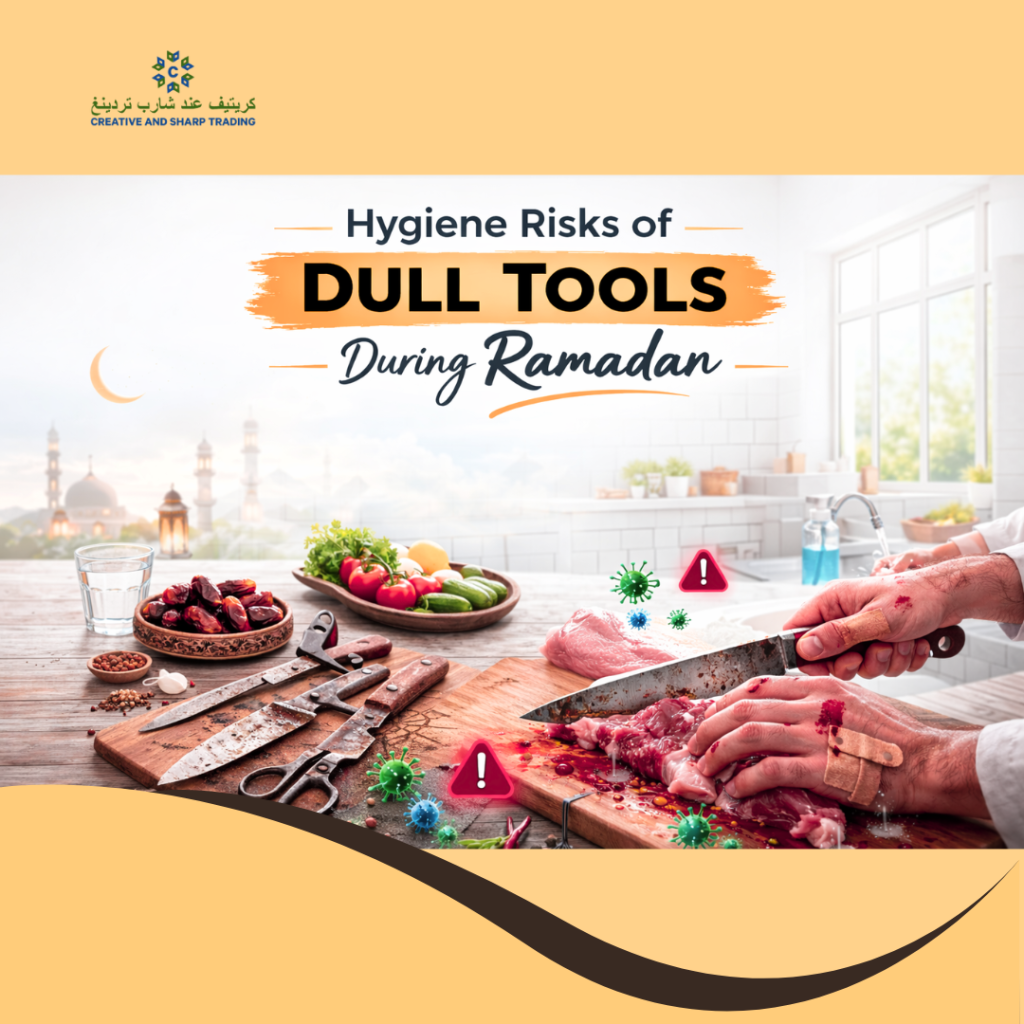
Why Blade Maintenance Is a Food Safety Priority — Not Just a Performance Issue
Ramadan significantly increases food preparation volumes across households, butcher shops, catering services, and commercial kitchens.
Higher demand means:
- Faster processing
- Longer operating hours
- Increased meat handling
- Reduced recovery time between batches
In this environment, tool sharpness becomes a hygiene control factor — not just an efficiency issue.
A dull blade is not merely inconvenient.
It is a contamination risk.
1. Tissue Damage & Bacterial Retention
A sharp blade slices cleanly through muscle fibers.
A dull blade:
- Tears tissue
- Crushes cell structure
- Creates uneven, porous surfaces
- Generates excess heat due to friction
These rough surfaces:
- Retain moisture
- Trap blood residue
- Increase microbial attachment points
In high-temperature Ramadan kitchens, bacterial growth accelerates.
Ragged cuts provide ideal micro-environments for contamination.
Clean cuts reduce:
✔ Surface area exposure
✔ Moisture retention
✔ Microbial adhesion
From a hygiene standpoint, precision cutting directly impacts food safety.
2. Increased Cross-Contamination Exposure
Dull tools require:
- More downward force
- Repeated sawing motion
- Longer contact time
This increases:
- Surface contact with cutting boards
- Hand repositioning
- Blade-to-product friction
The more movement and pressure involved, the greater the chance of:
• Slipping into adjacent products
• Spreading raw contaminants
• Touching unintended surfaces
During Ramadan peak hours, speed pressures amplify these risks.
A sharp blade minimizes:
✔ Repeated strokes
✔ Excess contact
✔ Uncontrolled movement
Precision equals control.
Control reduces contamination pathways.
3. Staff Fatigue During Fasting Hours
Fasting affects hydration, energy levels, and muscle endurance.
When staff use dull tools:
- Grip force increases
- Wrist strain rises
- Shoulder fatigue builds
- Reaction time slows
Fatigue combined with resistance cutting creates:
- Slipping hazards
- Inconsistent cuts
- Accidental contamination
- Injury risk
Ironically, dull blades often cause more accidents than sharp ones because operators apply excessive force.
Sharp tools:
✔ Require less pressure
✔ Improve ergonomic safety
✔ Reduce cumulative strain
✔ Lower incident probability
During Ramadan, this matters even more.
4. Edge Damage & Sanitation Gaps
Dull blades develop:
- Micro-chipping
- Edge rolling
- Uneven bevel geometry
- Surface microfractures
These imperfections:
- Trap protein residue
- Resist complete sanitization
- Harbor bacterial buildup
Even thorough washing cannot fully sanitize irregular edge damage.
Professional sharpening restores:
✔ Uniform edge geometry
✔ Smooth micro-surface
✔ Proper bevel alignment
✔ Easier cleaning compliance
This directly supports hygiene protocols and inspection standards.
5. Operational & Reputational Risk
Increased Ramadan volume means:
- More customers
- Faster turnaround
- Higher visibility
- Greater brand exposure
A single hygiene lapse can result in:
- Product spoilage
- Customer complaints
- Reputation damage
- Financial loss
Preventive maintenance is significantly less costly than corrective response.
Sharp tools are not an expense.
They are a risk control mechanism.
6. The Hidden Cost of DIY Sharpening
Many businesses attempt quick grinding or improper honing during peak demand.
Improper sharpening causes:
- Blade overheating
- Metal fatigue
- Irregular edge angles
- Reduced blade lifespan
Inconsistent edge geometry leads to:
- Poor performance
- Accelerated dulling
- Greater hygiene risk
Professional sharpening ensures:
✔ Correct angle preservation
✔ Heat control
✔ Edge balance
✔ Longer tool lifespan
Ramadan Maintenance Protocol Recommendation
Before peak service hours:
✓ Inspect all primary cutting tools
✓ Remove visibly damaged blades
✓ Schedule professional sharpening
✓ Maintain rotation sets
✓ Sanitize post-sharpening properly
✓ Implement routine inspection intervals
Proactive maintenance supports:
• Hygiene integrity
• Staff safety
• Operational efficiency
• Customer trust
Final Perspective
Ramadan is a time of discipline, responsibility, and community trust.
In food businesses, that trust begins behind the counter — with the tools in your hands.
A sharp blade represents:
Precision
Care
Professionalism
Hygiene commitment
Neglected tools quietly increase risk.
Maintained tools reinforce standards.
This Ramadan, sharpness is not just about cutting better.
It’s about protecting health, reputation, and operational excellence.