
Introduction
In professional and home kitchens alike, sharp knives are essential. However, beyond just being “sharp,” the angle at which a blade is sharpened plays a critical role in its cutting performance, durability, and suitability for specific tasks. Understanding sharpening angles allows chefs and cooks to choose and maintain the right edge geometry for each application, improving both efficiency and safety in food preparation.
What Is a Sharpening Angle?
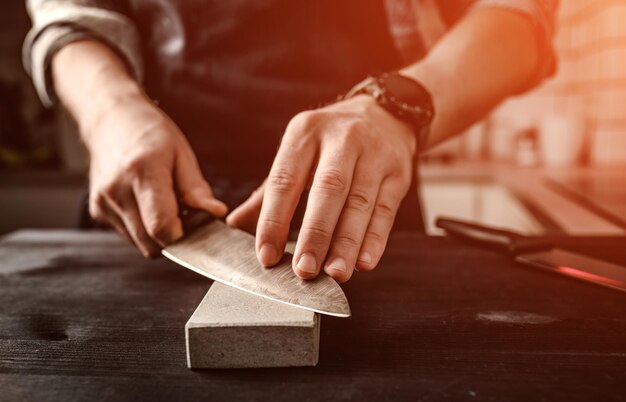
The sharpening angle refers to the angle between the knife’s bevel and a sharpening surface. For double-beveled knives (common in Western kitchens), this angle is measured per side. For example, sharpening each side at 20° results in a total edge angle of 40°.
The sharpening angle determines the thinness and strength of the blade’s edge:
- Lower angles (12°–17°) create a finer, sharper edge ideal for precise slicing.
- Higher angles (18°–25°) produce a stronger, more durable edge for heavy-duty use.
How Sharpening Angle Affects Knife Performance?
1. Sharpness vs. Edge Strength
- Lower Angles (12°–17° per side)
These produce extremely sharp edges, suitable for cutting soft or delicate foods like fish, tomatoes, or herbs.
Trade-off: They dull faster and are more prone to chipping if used on hard materials. - Higher Angles (18°–25° per side)
These offer more durability and are better for cutting dense or tough ingredients such as root vegetables or bone-in meat.
Trade-off: Slightly reduced initial sharpness compared to finer angles.
2. Matching Angle to Knife Type and Function
Different knives are designed with specific tasks in mind — and their optimal sharpening angles reflect that:
| Knife Type | Recommended Angle (per side) | Purpose |
|---|---|---|
| Japanese Chef’s Knife | 12°–15° | Precision slicing, delicate cuts |
| Western Chef’s Knife | 18°–22° | Versatile tasks, general-purpose use |
| Paring/Utility Knife | 15°–20° | Peeling, trimming, fine control |
| Butcher/Cleaver | 22°–25° | Tough cutting, durability over finesse |
Choosing the correct sharpening angle ensures the knife performs as intended and lasts longer between maintenance.
3. Impact on Culinary Quality
The sharpening angle directly influences:
- Cutting accuracy — essential for uniform slicing and presentation
- Preparation speed — less resistance means smoother motion and faster work
- Food integrity — sharp blades reduce bruising and tearing, preserving texture
In commercial kitchens, maintaining proper edge geometry is not just a matter of preference — it is a standard for operational efficiency.
Why Professional Sharpening Is Recommended?
Maintaining a consistent and correct sharpening angle is difficult with basic tools. Even minor inconsistencies can result in uneven edges or reduce blade life.
Professional sharpening services use calibrated equipment and expertise to:
- Restore factory-grade edge geometry
- Match the edge profile to the knife’s original or optimal angle
- Extend the functional lifespan of high-quality culinary knives
This is particularly important for premium blades, such as Japanese knives or Damascus steel, which are often forged with precise edge angles that should be preserved.
Conclusion
Sharpening angles are more than just a technical detail — they are a core component of knife performance. Selecting and maintaining the right angle enhances sharpness, durability, and culinary results. For chefs and culinary professionals, knowing which angle to use — and when to seek expert sharpening — is essential to maintaining peak kitchen performance.
A sharp blade is only effective if it’s sharpened correctly.