
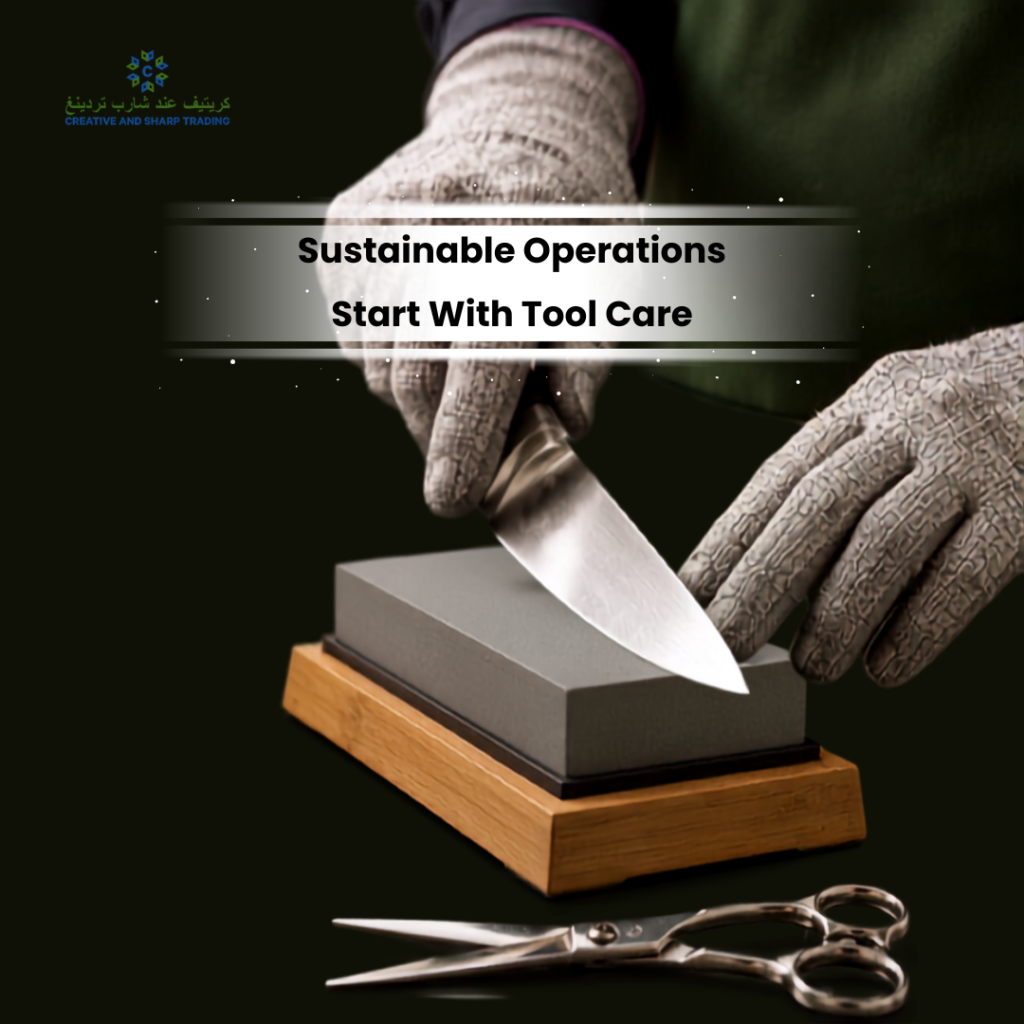
Why Tool Maintenance Is One of the Most Overlooked Sustainability Practices?
When organizations talk about sustainability, the conversation usually revolves around energy efficiency, renewable resources, waste management, or carbon reduction. While these initiatives are essential, one critical factor often receives far less attention—the condition of the tools used every day on the production floor.
Every cutting tool has a finite lifespan. How that lifespan is managed directly affects productivity, operating costs, product quality, energy consumption, and environmental impact.
Tool maintenance is more than a routine maintenance activity. It is a practical business strategy that supports operational efficiency while reducing unnecessary waste and extending the value of existing resources.
Organizations committed to sustainable manufacturing understand that maintaining and sharpening tools is just as important as investing in modern equipment.
The Hidden Cost of Poor Tool Care
Cutting tools rarely fail without warning. Their performance gradually declines as cutting edges wear, heat increases, and precision decreases.
Unfortunately, many businesses continue using worn tools until they completely fail. By that stage, the cost extends far beyond replacing a single tool.
Poorly maintained tools often lead to:
- Increased material waste
- Reduced machining accuracy
- Poor surface finishes
- Higher machine loads
- Longer production cycles
- Increased energy consumption
- Unexpected machine downtime
- More frequent tool replacement
Each of these issues affects productivity, profitability, and sustainability.
Many organizations treat these as separate operational problems, when in reality they often stem from one common cause—insufficient tool maintenance.
Sustainability Means Making Better Use of Resources
Sustainability isn’t only about reducing environmental impact—it’s about using available resources more efficiently.
Every cutting tool represents an investment of:
- Raw materials
- Manufacturing energy
- Transportation
- Packaging
- Procurement costs
Replacing a tool before it reaches the end of its usable life also means replacing all of those invested resources.
Professional tool sharpening helps restore cutting performance, allowing quality tools to continue delivering reliable results instead of being discarded prematurely.
Extending tool life is one of the simplest and most effective ways to reduce waste while maintaining productivity.
Sharpening Does More Than Extend Tool Life
Professional sharpening benefits the entire manufacturing process—not just the tool itself.
Improved Cutting Performance
A sharp cutting edge removes material cleanly and efficiently with less resistance.
This improves machining consistency while reducing unnecessary strain on both the tool and the machine.
Better Product Quality
The condition of a cutting tool directly affects the quality of the finished product.
Properly sharpened tools help maintain:
- Dimensional accuracy
- Smooth surface finishes
- Consistent product quality
- Lower rejection rates
When tool performance declines, product quality often declines with it.
Lower Energy Consumption
Dull tools require greater cutting force to perform the same operation.
That additional force increases:
- Machine load
- Spindle stress
- Power consumption
- Heat generation
Sharp tools reduce resistance, allowing machines to operate more efficiently while consuming less energy.
Although the savings from one tool may appear small, the cumulative impact across hundreds or thousands of production cycles can be substantial.
Reduced Material Waste
Poor cutting performance often causes:
- Chipped materials
- Burn marks
- Rough finishes
- Dimensional inconsistencies
- Rework
- Scrap
Every rejected component represents wasted material, wasted machine time, and additional production costs.
Maintaining tool sharpness helps minimize these avoidable losses.
Healthy Tools Support Healthy Machines
Machines and cutting tools operate as one integrated system.
When a cutting edge becomes dull, machines compensate by applying greater force.
Over time, this additional stress accelerates wear on critical machine components, including:
- Bearings
- Motors
- Spindles
- Drive systems
- Cooling components
Routine tool maintenance helps reduce mechanical stress, extend machine life, and lower maintenance costs.
Protecting tools also helps protect the equipment that depends on them.
Preventive Maintenance Is Better Than Emergency Replacement
Many organizations replace tools only after production quality begins to suffer.
This reactive approach often results in:
- Unexpected downtime
- Delayed deliveries
- Interrupted production schedules
- Emergency purchases
- Higher operating costs
A preventive sharpening schedule offers a more reliable solution.
Regular inspections and timely sharpening restore tool performance before serious issues develop, helping maintain production continuity and reduce unexpected disruptions.
Planned maintenance supports predictable operations.
Sustainability and Cost Reduction Go Hand in Hand
Many businesses still view sustainability as an additional cost.
In reality, sustainable practices often improve financial performance.
Professional tool care helps organizations:
- Reduce replacement tool purchases
- Lower production waste
- Improve machining efficiency
- Extend machine life
- Reduce maintenance costs
- Increase operational reliability
Environmental responsibility and operational efficiency are not competing goals—they support one another.
Using fewer resources more effectively benefits both the business and the environment.
Why Professional Tool Sharpening Matters?
Not all sharpening services produce the same results.
Professional tool sharpening requires precision equipment, skilled technicians, and a thorough understanding of cutting tool geometry.
A properly sharpened tool should restore cutting performance while preserving the original geometry, balance, and accuracy required for consistent machining.
Poor sharpening practices can shorten tool life, reduce cutting efficiency, increase machine wear, and negatively affect product quality.
Choosing an experienced sharpening partner helps ensure your tools return to production performing at their best, delivering reliable results over multiple sharpening cycles.
Tool Care Is Part of Operational Excellence
Successful manufacturers understand that consistent performance depends on attention to detail.
Machine calibration, preventive maintenance, quality control, and operator training are all important—but none can compensate for poorly maintained cutting tools.
Reliable production begins with reliable tooling.
Organizations that prioritize tool care experience:
- Higher productivity
- Better product consistency
- Lower operating costs
- Reduced downtime
- Longer equipment life
- Improved sustainability performance
Tool maintenance is not simply about preserving equipment—it is about improving the entire manufacturing process.
Final Thoughts
Sustainable operations are built through consistent, practical decisions—not just large investments or ambitious environmental initiatives. Proper tool care is one of those decisions that delivers measurable value every day.
By maintaining cutting tools through regular inspections, professional sharpening, and preventive maintenance, businesses can reduce waste, extend tool life, improve machining accuracy, lower energy consumption, and keep production running efficiently. These improvements not only support sustainability goals but also contribute to stronger operational performance and long-term cost savings.
At CNS Trading, we help businesses across Doha and Qatar maximize the performance and lifespan of their cutting tools through professional tool sharpening services. Our focus is on precision, consistency, and reliability, enabling manufacturers to improve productivity while reducing unnecessary tool replacement and material waste.
To make the process even more convenient, CNS Trading also offers pick-up and delivery services, allowing customers to maintain their tooling with minimal disruption to daily operations.
Sustainable manufacturing doesn’t begin with buying more—it begins with taking better care of the tools you already have.